
Cylindrical Roller Bearings
SKF ball, roller and mounted bearings for machine builders, distributors and project buyers



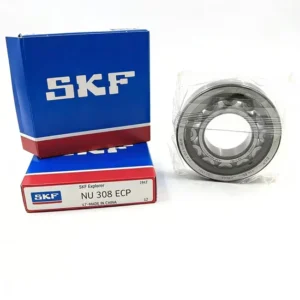

SKF NU308ECP Cylindrical Roller Bearing 40×90×23 mm — features an optimized internal design for enhanced radial load capacity and extended durability in precision machinery.
Product Details
Mixed-Brand Sourcing — Consolidate your SKF NU308ECP cylindrical roller bearing order with other premium lines in a single shipment without juggling multiple vendors.
| Parameter | Value |
|---|---|
| Designation | NU308ECP |
| Bearing Type | Cylindrical Roller Bearing |
| Bore Diameter (d) | 40 mm |
| Outside Diameter (D) | 90 mm |
| Width (B) | 23 mm |
| Number of Rows | Single |
| Load Direction | Radial |
| Cage Material | Glass fiber-reinforced polyamide |
| Material | Bearing Steel |
| Industry | Typical Applications |
|---|---|
| Precision Machinery | High-speed spindle drives and precision indexing tables |
| Heavy-Duty Gearboxes | Industrial reduction gears and extruder drives |
| Rolling Mills | Guide roll assemblies and auxiliary drive shafts |
| Traction Motors | Electric motor rotor shaft supports |
The optimized internal geometry and specific polyamide cage design prevent catastrophic seizure under high-speed thermal expansion.
I have seen precision spindles fail spectacularly because buyers ignored the cage suffix on their SKF NU308ECP cylindrical roller bearing, substituting a brass cage where a polymer one was specified for high-speed thermal stability, or vice versa. In one severe case, a mismatched cage material led to excessive centrifugal forces, causing the rollers to skid and the raceways to smear within hours of startup. Such failures are rarely due to poor metallurgy; instead, they stem from a fundamental misunderstanding of the application's dynamic requirements. When sourcing critical components, overlooking these nuanced design features inevitably results in unplanned downtime and costly secondary damage to the surrounding housing and shaft assemblies.
When specifying a SKF NU308ECP cylindrical roller bearing for precision machinery, the primary focus must be on radial load capacity and high-speed stability. The single-row configuration is inherently designed to handle substantial radial forces while permitting axial displacement, which is crucial for accommodating thermal expansion in long shaft arrangements. Our engineering team cross-references your exact operating speeds, thermal profiles, and load vectors to ensure the polyamide cage and optimized roller geometry align perfectly with your spindle or gearbox requirements. By thoroughly analyzing the specific operational envelope, we prevent the common pitfall of over-specifying or under-specifying the internal clearance, thereby securing long-term reliability for your most critical rotating equipment.
High-speed precision spindles generate significant frictional heat, which directly impacts internal clearance and lubricant viscosity during continuous operation. If the operating temperature exceeds the thermal limit of standard bearing steel, the polyamide cage could degrade, while inadequate oil flow inevitably leads to roller skidding and surface distress. Properly matching the clearance class to the thermal expansion of the shaft and housing is critical to prevent preload loss or excessive friction that would otherwise compromise machining accuracy. Furthermore, the chosen lubrication method must effectively dissipate heat without introducing excessive fluid friction, a balance that requires careful calculation of the base oil viscosity and delivery rate.
The ECP suffix on this designation indicates an optimized internal design paired with a glass fiber-reinforced polyamide cage centered on the rollers. This specific cage material offers a highly favorable balance of low weight and high strength, drastically reducing centrifugal forces at elevated speeds compared to traditional brass alternatives. The single-row radial configuration is engineered to accommodate heavy radial loads while allowing for necessary axial displacement within the housing, preventing binding during thermal growth. Furthermore, the precise dimensional envelope ensures direct interchangeability with standard metric housings, provided the shaft and housing tolerances are machined to match the selected precision class. Understanding these specific design choices allows maintenance engineers to make informed decisions when evaluating replacement intervals or upgrading legacy machinery.
Substituting the correct cage material or clearance class often leads to unplanned downtime and premature failure of the entire spindle assembly. When a bearing operates outside its designed thermal or speed envelope, the resulting catastrophic damage can void machinery warranties and halt production lines for extended periods. According to established industry frameworks, a significant share of premature failures stems directly from improper selection and installation errors rather than inherent manufacturing defects. The hidden costs of these mistakes extend far beyond the price of a single replacement component, encompassing lost production revenue, emergency shipping fees, and the labor required to dismantle and rebuild complex gearboxes or spindle units.
Sourcing genuine components requires more than just matching a part number; it demands rigorous traceability and technical validation at every step. We verify the specific suffix and precision class against the manufacturer's production facilities to ensure you receive the exact optimized design required for your application. Our massive spot inventory covers thousands of standard part numbers, allowing us to fulfill urgent maintenance requirements without enduring typical multi-week lead times that disrupt production schedules. Additionally, we provide cross-brand equivalent model consultation if you need to evaluate alternative options for legacy equipment, ensuring that any substitution maintains the original engineering intent. This comprehensive approach to sourcing guarantees that your procurement process is both efficient and technically sound.
To ensure optimal performance and longevity, please share your specific radial loads, operating speeds, and steady-state temperatures so our team can verify the calculated life and clearance requirements. Providing the original equipment manufacturer part number or exact housing dimensions allows us to conduct a precise cross-reference check and identify any potential fitment issues. This thorough technical review guarantees that the selected configuration perfectly matches your precision machinery environment, eliminating the guesswork often associated with standard catalog ordering. By collaborating on these critical parameters, we help you avoid costly trial-and-error installations and secure a reliable, long-term solution for your rotating equipment.
Q: What does the ECP suffix mean for this specific cylindrical roller bearing?
A: The ECP suffix indicates an optimized internal design featuring a glass fiber-reinforced polyamide cage centered on the rollers. This configuration reduces weight and centrifugal forces, making it highly suitable for high-speed precision machinery applications where thermal stability and low friction are critical for maintaining rotational accuracy.
Q: How can I verify the authenticity of the bearing before installation?
A: You can verify authenticity by scanning the QR code on the packaging using the manufacturer's official mobile application. This digital check confirms the production batch and origin. Additionally, we provide a Certificate of Conformity and traceability documentation with every shipment to guarantee you receive genuine components.
Q: How do I select the correct precision rating for my precision machinery?
A: Selecting the right precision class depends on your spindle's required runout limits and rotational speed. Higher precision ratings minimize vibration and heat generation in high-speed applications. Share your specific tolerance requirements and operating speeds with our engineering team, and we will recommend the appropriate class to ensure optimal performance.
Q: What are the cross-reference considerations when replacing this bearing?
A: When replacing this component, you must match the internal geometry, cage material, and clearance class, not just the outer dimensions. Substituting a brass cage for the original polyamide design can alter the speed limit and thermal behavior. Always consult our technical team to verify equivalent models and ensure compatibility with your existing housing.
Q: What are the recommended lubrication practices for single row cylindrical roller bearings?
A: Proper lubrication requires selecting an oil or grease with the correct base oil viscosity for your operating speed and temperature. For high-speed precision spindles, oil-air or oil-mist lubrication is often preferred to minimize frictional heat. Always follow the manufacturer's relubrication intervals to prevent starvation and protect the optimized roller profiles.
Before You Enquire
A complete enquiry ties every price to the right execution, drawing and project stage. It also catches the sleeves and locking components that BOMs often leave out.
Send Your BOMSame Product Family
These bearings share a category with this model, so you can review them together when one BOM covers several lines.
Cylindrical Roller Bearings
Cylindrical Roller Bearings

Agricultural Machinery Bearings

Cylindrical Roller Bearings
Where It Fits
This bearing is listed for the applications below. Open each one to see the related product categories.
 Machinery Parts Distribution Machinery parts distributors stock and resell standard bearings for general machinery, automotive and light-vehicle customers, often across many sizes on a single purchase list.… Ball Bearings · Roller Bearings · Sealed and Shielded Bearings · Inch Size Bearings
 Power Transmission & Rotating Equipment Gearboxes, reducers, pumps, compressors, blowers, conveyors and wind turbine drivetrains depend on bearings that carry combined radial and axial loads at sustained speeds. Shock… Cylindrical Roller Bearings · Tapered Roller Bearings · Spherical Roller Bearings · Self-Aligning Ball Bearings
Technical Reading
These articles support bearing selection and specification checks for this product type.

Sep 15, 2026 · Brands & Alternatives
Source Equivalent Bearings for OEM Spare Parts Lists by matching technical specifications like clearance and load ratings instead of rigid brand names. This cross-brand…
Sep 15, 2026 · Procurement & Trade FAQs
Manage field failure returns from OEM customers by identifying root causes like seal失效 or improper lubrication rather than assuming manufacturing defects. Implement systematic analysis…
Sep 16, 2026 · News & Cases
Master Supply Chain Diversification 2026 for OEMs by balancing multi-brand bearing sourcing with strict customs compliance to avoid production halts. Align HS codes and…
الأسئلة الشائعة
The exact execution is confirmed before you accept a product quote. Share the BOM line and drawing revision. If the marking on an old bearing is incomplete, send a clear photo and note what still needs checking.
List each stage as its own quantity with its own required date. Prototype, production and spare quantities can then appear separately in one project quote, so planners can schedule each stage on its own timing.
State the BOM line, the drawing revision and whether alternatives are allowed. A separately identified alternative is settled before the product quote is accepted. Technical changes require buyer approval, so your design engineer keeps control of the specification.
Product documents are confirmed at the written quote stage, order by order. List the documents your project requires in your enquiry. Transport documents are confirmed with the shipping arrangements for the order.
Request a Quote
SKF Mechanical and Electrical Equipment supplies SKF ball, roller and mounted bearings to buyers worldwide. Your written quote states model, quantity, price and currency, availability, estimated lead time and validity.