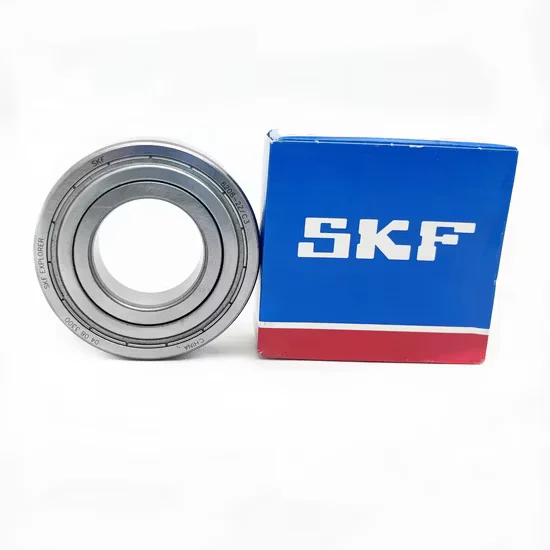
SKF 6003-2RSH Bearing Wholesale Supplier & Bulk for Sale
- Product & Series Guides
- Sep 16, 2026
- author
Most buyers order the wrong suffix.
The core specification for an SKF 6003-2RSH is not just its 17x35x10 mm physical dimension, but the specific nitrile rubber sealing and lithium-based grease formulation indicated by the suffix. Selecting the correct variant requires matching these hidden parameters to the operating temperature and speed of the application to prevent premature seal degradation or grease carbonization.
I learned this lesson the hard way in a dusty port office, staring at a customs declaration that looked perfect on paper. The model number was correct. The quantity matched the purchase order. The brand was genuine. Yet, when the container arrived at a client’s facility in the Middle East, the feedback was not a thank-you note, but a video of seized motor shafts. The bearings had been installed in high-temperature motors, but I had shipped the standard version. The generic lithium grease inside had baked into a solid block within days. That incident shifted my focus from merely moving boxes to understanding the microscopic details that determine whether a bearing runs for years or fails in weeks. For any serious procurement team, understanding the technical nuance behind SKF 6003-2RSH specs is the difference between a reliable supply chain and a costly recall.
This guide breaks down the critical dimensions, load capacities, and suffix meanings that define this specific deep groove ball bearing. It is designed for distributors and MRO purchasers who need to verify stock accuracy and provide technical confidence to their end-users.
What Are the Core Dimensions of SKF 6003-2RSH?
Physical fit is the non-negotiable first step.
Before discussing load ratings or grease types, the bearing must physically fit the housing and shaft. The SKF 6003-2RSH dimensions are standardized under ISO 15, ensuring interchangeability across major brands, but precision in measurement remains vital for high-speed applications.
The basic boundary dimensions are:
- Bore Diameter (d): 17 mm
- Outside Diameter (D): 35 mm
- Width (B): 10 mm
These measurements define the bearing series as a "light" or "extra-light" duty option, commonly used in small electric motors, household appliances, and light industrial gearboxes. The weight is approximately 0.03 kg, which makes it easy to handle but also means it has limited mass to absorb shock loads compared to larger counterparts.
| Parameter | Value | Standard Reference |
|---|---|---|
| Bore Diameter | 17 mm | ISO 15 |
| Outside Diameter | 35 mm | ISO 15 |
| Width | 10 mm | ISO 15 |
| Chamfer Dimension | Min 0.3 mm | ISO 15 |
When sourcing SKF 6003-2RSH bearing specifications, buyers often overlook the tolerance class. Standard production usually meets Normal (P0) tolerance, which is sufficient for most general industrial uses. However, for precision spindles or high-speed motors, requesting P5 or P4 tolerance classes becomes necessary. These higher precision grades ensure tighter runout and reduced vibration, but they come at a premium cost and longer lead times. Verifying the required tolerance level before placing a bulk order prevents the common issue of receiving technically correct but functionally inadequate stock.
How Do Load Ratings and Speed Limits Define Its Capacity?
Exceeding speed limits generates heat faster than seals can dissipate it.
The operational lifespan of a bearing is dictated by its dynamic load rating and limiting speed. For the SKF 6003-2RSH, these values are not arbitrary; they are calculated based on the geometry of the balls, the raceway curvature, and the cage design.
The basic dynamic load rating (C) is approximately 6.37 kN. This figure represents the constant radial load that a group of identical bearings can endure for one million revolutions with a 90% survival rate. The static load rating (C0) is around 2.6 kN, which is critical for applications where the bearing is stationary under load, such as in pivot points or heavy-start scenarios.
However, the more immediate constraint for many users is the limiting speed. With standard lubrication and normal clearance, the reference speed is roughly 13,000 r/min, while the limiting speed can reach up to 19,000 r/min. Exceeding these speeds without specialized cooling or lubrication leads to rapid temperature rise. In a sealed unit like the 2RSH, this heat is trapped inside, accelerating grease oxidation.
A European machinery OEM once reported intermittent failures in their conveyor drives. The load was well within the 6.37 kN limit, but the operational speed hovered near the upper threshold. The issue was not the load, but the frictional heat generated by the contact seals at high RPM. Switching to a low-friction variant or ensuring adequate cooling resolved the issue. This highlights why understanding SKF 6003-2RSH specs involves more than just checking if the shaft fits; it requires analyzing the thermal environment.
What Does the "2RSH" Suffix Really Mean for Sealing?
Contact seals protect against contaminants but create friction.
The suffix "2RSH" is often treated as a generic label for "sealed," but it carries specific technical implications regarding material and performance. The "2" indicates seals on both sides. The "RS" denotes a contact seal made of Nitrile Butadiene Rubber (NBR). The "H" typically refers to a specific design variant or reinforcement in certain SKF naming conventions, often implying a robust lip design for better sealing efficiency.
NBR is chosen for its excellent resistance to oils and greases, as well as its ability to maintain elasticity over a wide temperature range. However, it has limits. The standard operating temperature for NBR seals is generally between -40°C and +100°C. Short-term exposure up to 120°C may be tolerated, but continuous operation at these higher temperatures causes the rubber to harden and lose its sealing lip tension. Once the lip hardens, contaminants enter, and grease leaks out.
In dusty environments, such as cement plants or agricultural machinery, the 2RSH design provides superior protection compared to open bearings or non-contact shields. The contact lip physically blocks particulate matter. However, this protection comes at the cost of increased starting torque and running friction. For high-speed applications, this friction can be detrimental.
Understanding the 6003-2RSH suffix meaning is crucial for matching the bearing to the environment. If the application involves frequent wash-downs or exposure to chemicals, standard NBR may not suffice, and alternative materials like Fluoroelastomer (FKM) might be required, though these would carry different suffixes. For most general industrial uses, the 2RSH offers a balanced solution for contamination exclusion.
Why Do Hidden Suffixes Cause Batch Failures in Motors?
The grease inside is the silent killer of high-temperature applications.
The most critical aspect of the SKF 6003-2RSH bearing specifications that is often overlooked is the lubricant. The standard 2RSH bearing is typically filled with a lithium-complex grease (such as LGMT 2 in SKF’s current lineup), which is suitable for general-purpose applications. However, "general purpose" does not mean "universal."
In my early days, I assumed that a sealed bearing was maintenance-free and therefore immune to lubrication issues. This assumption led to the batch failure mentioned earlier. The client was using these bearings in small fans for industrial ovens. The ambient temperature inside the housing regularly exceeded 80°C. The standard lithium grease began to bleed and oxidize, leaving the rolling elements dry. The resulting friction caused the bearings to seize.
To avoid this, one must look beyond the base model number. SKF offers variants with different grease fillings and clearance classes. For high-temperature applications, a bearing with a high-temperature grease suffix or a C3 internal clearance is often necessary. C3 clearance allows for thermal expansion of the inner ring and shaft, preventing excessive preload that generates heat.
| Application Condition | Recommended Feature | Reason |
|---|---|---|
| Standard Ambient | Standard Grease / Normal Clearance | Cost-effective, sufficient for most uses |
| High Temperature (>80°C) | High-Temp Grease / C3 Clearance | Prevents grease breakdown and thermal preload |
| High Speed | Low-Friction Grease / CN Clearance | Reduces heat generation from churning |
| Heavy Vibration | Solid Lubricant / Special Cage | Prevents grease migration and cage wear |
When procuring SKF 6003-2RSH units for specific industrial tasks, asking for the full technical data sheet reveals these hidden variables. A supplier who can explain the difference between LGMT 2 and HT grease adds value beyond simple logistics. This level of technical scrutiny ensures that the bearing selected is not just a mechanical fit, but a chemical and thermal match for the application.
Conclusion
Precision in specification prevents failure in operation.
The SKF 6003-2RSH is a versatile component, but its reliability depends on aligning its physical dimensions, seal capabilities, and internal lubrication with the specific demands of the machinery. Buyers must look past the basic model number to understand the implications of the 2RSH suffix and the hidden variables of grease and clearance. By focusing on these technical details, distributors and engineers can ensure long-term performance and avoid the costly pitfalls of mismatched components.